

Overview: Gorakshep
Introduction
Nestled beneath the mighty Everest and surrounded by icy wilderness, Gorakshep is a symbolic highland outpost. It’s where nature, adventure, and spirituality come together. Often called the last human settlement before Everest Base Camp, Gorakshep is more than a resting point. It holds the legacy of Sherpa strength, offers sweeping views of Himalayan giants, and welcomes trekkers chasing high-altitude dreams. For travelers in Nepal’s Khumbu region, Gorakshep marks a turning point. Here, thin air meets limitless inspiration.
About Gorakshep
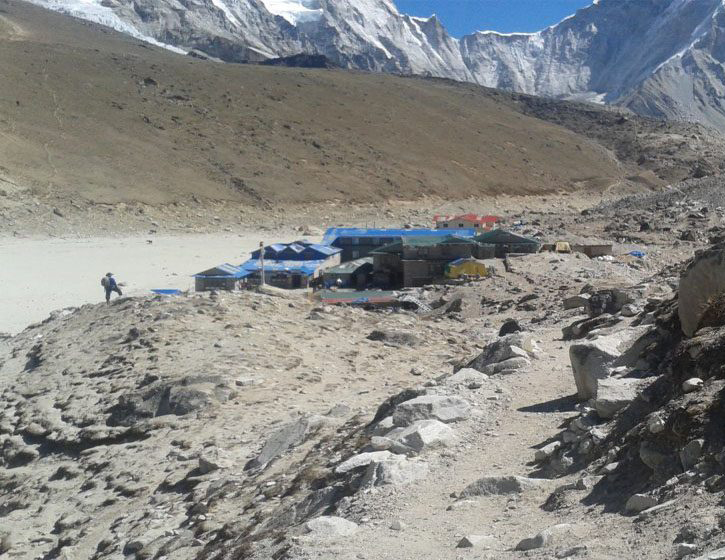
The name “Gorakshep” originates from the words ‘Gorak’ (a revered sage or holy man) and ‘Shep’ (meaning lake or frozen pond), referencing the ancient frozen lakes that once covered this desolate basin. Today, Gorakshep rests at an elevation of approximately 5,164 meters (16,942 feet) above sea level and is considered the gateway to Everest Base Camp and the best launching pad for climbing Kala Patthar, the famed viewpoint offering one of the clearest, closest vistas of Mount Everest.
Despite its remote setting, Gorakshep is rich in cultural echoes and natural elements. Originally a yak pasture and a staging ground for early Everest summiteers, it has gradually evolved into a compact yet vital outpost for trekkers.
Geographical Location
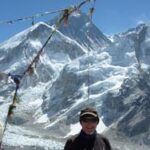
Gorakshep is located in Sagarmatha National Park, within Nepal’s Solukhumbu District. It sits northwest of the Khumbu Glacier, just beneath the foothills of Mount Everest. Positioned between Lobuche and Everest Base Camp, it is surrounded by towering giants like Nuptse, Pumori, Lingtren, and Everest itself.
The area showcases a stark yet stunning landscape of glaciers, rocky ridges, and high-altitude isolation. Roughly 200 kilometers northeast of Kathmandu, Gorakshep lies deep in the Himalayas—far beyond the reach of any roads.
How to Reach Gorakshep
The journey to Gorakshep is both physically demanding and emotionally stirring. Most adventurers start their journey with a short flight from Kathmandu to Lukla. This mountain airstrip is famous for its thrilling landings. From Lukla, trekkers move through a series of charming villages—Phakding, Namche Bazaar, and Tengboche—each offering unique views and cultural encounters. Dingboche and Lobuche—before finally reaching Gorakshep.
The entire route forms part of the famed Everest Base Camp Trek, requiring 8 to 10 days of walking through a range of altitudes and landscapes. Helicopter charters are available for those seeking swift access or medical evacuation, but most visitors opt for the trek to fully embrace the landscape’s transformation and build essential acclimatization.
Local Inhabitants
Though Gorakshep itself has no permanent population, it is managed and maintained by the resilient Sherpa people, who hail from neighboring villages such as Pangboche and Dingboche. These indigenous highlanders serve as lodge operators, cooks, porters, and guides, offering their deep-rooted knowledge of the region and unparalleled hospitality to global travelers.
Sherpas, famed for their high-altitude adaptability and spiritual devotion, are the backbone of Himalayan trekking culture. Their presence ensures safety, warmth, and authenticity in an otherwise stark wilderness.
Lodging and Amenities
Accommodation in Gorakshep is modest yet functional, catering primarily to the needs of trekkers and climbers. Teahouses and guest lodges dominate the landscape, providing shared rooms with twin beds, insulated walls, and heavy blankets. While these lodges may lack the luxuries of lower-altitude hotels, they offer hearty meals, boiled water, and a communal atmosphere that brings trekkers together from every corner of the world.
Electricity is available in most lodges via solar power or limited generators, and Wi-Fi access is possible—though inconsistent and often dependent on weather. Toilets are primarily shared, and showers (when operational) are limited due to the altitude and freezing temperatures.
Spiritual and Religious Significance
While Gorakshep may not host grand temples or stupas, it is imbued with spiritual reverence through the footprints of pilgrims, the prayer flags fluttering in icy winds, and the ever-present Himalayas—regarded by locals as sacred abodes of gods and protective spirits.
Nearby Tengboche Monastery—visited on the way to Gorakshep—is a spiritual highlight of the trek, where monks bless travelers and rituals are performed to seek safe passage through the mountains. Many Sherpa traditions are deeply connected to Buddhist teachings, and the surrounding terrain is considered an extension of their spiritual landscape.
Lifestyle at High Altitude
Life in Gorakshep revolves around adaptation, simplicity, and survival. For trekkers, daily routines include early morning climbs to Kala Patthar, resting in teahouses, and staying hydrated to combat altitude-related challenges. For Sherpa lodge owners and workers, life consists of preparing meals, maintaining lodges, and helping travelers acclimate safely.
Despite the hardships, there exists a strong sense of community and camaraderie at Gorakshep, where strangers share stories, laughter, and meals under candlelit dining halls. The rhythm of life is slow, dictated by weather, altitude, and the occasional crackle of a satellite phone or headlamp beam piercing the night.
Flora and Fauna
Gorakshep sits above the tree line, meaning vegetation is sparse and wildlife sightings are rare. However, the Sagarmatha National Park, through which trekkers ascend, is a UNESCO World Heritage Site rich in biodiversity. As visitors climb higher, lush forests of rhododendron and pine give way to alpine shrubs, mosses, and lichens.
Wildlife such as Himalayan tahr, snow leopard, red panda, and Danphe (Nepal’s national bird) inhabit lower altitudes, but above 5,000 meters, life becomes rarer. Occasionally, one might glimpse choughs (black alpine crows) circling above or hear the whistle of a pika darting among the rocks.
Vegetation and Environment
The terrain surrounding Gorakshep is characterized by moraines, boulders, glacial scree, and permafrost. Vegetation is minimal and mostly limited to alpine mosses, lichens, and cold-resistant grasses. In the harsh climate, where oxygen levels drop and temperatures plummet below freezing even in spring, plant life clings to the rock with silent resilience.
The dry, arid air, strong UV exposure, and occasional snow flurries create an otherworldly environment. Despite its harshness, Gorakshep’s stark beauty leaves a profound imprint on all who venture this far.
Climate and Atmosphere
The atmosphere at Gorakshep is thin, crisp, and often surreal. The sky appears deeper blue, and the surrounding peaks reflect light in brilliant, crystalline hues. Days are often sunny and dry, while nights drop well below zero degrees Celsius.
Weather conditions can change rapidly—clear mornings may give way to snowy whiteouts by afternoon. The air pressure is low, and oxygen levels hover around 50% of sea level, which makes even short climbs exhausting.
Still, there’s a spiritual clarity to the environment. The silence is powerful, broken only by the wind or distant sound of yaks’ bells. The ambiance is unlike anywhere else—a mix of awe, exertion, and enlightenment.
One of Nepal’s Most Treasured Trekking Areas
The Everest region, with Gorakshep at its core, is one of the most admired trekking destinations in Nepal and the world. The trail to Gorakshep and beyond draws thousands annually for its unbeatable views, personal challenge, and Himalayan grandeur.
It offers a complete trekking experience—cultural immersion, natural wonders, spiritual touchpoints, and high-altitude triumph. Alongside Everest Base Camp and Kala Patthar, Gorakshep stands as a critical landmark in this hallowed route.
Services by The Himalayan Realms Treks and Nepal Freelance Guides
At The Himalayan Realms Treks and Expedition Nepal Pvt. Ltd., we offer safe, authentic, and unforgettable journeys to Gorakshep and beyond. Our Everest region treks include personalized support, careful acclimatization, and reliable logistics. This ensures your high-altitude adventure is both smooth and rewarding.
We work closely with local freelance Nepali guides. Each one is certified, experienced, and deeply familiar with the terrain. Their passion for storytelling, culture, and safety offers travelers more than a tour. It creates a genuine connection to Nepal’s heart. Our company also champions eco-friendly trekking practices, responsible tourism, and support for local communities, making your journey both meaningful and sustainable.
Conclusion
Gorakshep sits within Sagarmatha National Park in Nepal’s Solukhumbu District. It lies northwest of the Khumbu Glacier, just below the foothills of Mount Everest. Nestled between Lobuche and Everest Base Camp, it is ringed by towering peaks like Nuptse, Pumori, Lingtren, and Everest.
The terrain here is stark and beautiful—marked by shifting glaciers, rocky ridges, and high-altitude solitude. Located about 200 kilometers northeast of Kathmandu, Gorakshep rests deep in the Himalayas, far beyond any motorable roads.