

Trip overview
Poon Hill–Jhinu Hot Spring 7-Day Trek:
Introduction
The Poon Hill–Jhinu Hot Spring Trek is one of the most captivating adventures in the Annapurna region of Nepal. This short yet rewarding trek offers the charm of traditional villages and panoramic Himalayan views. It also includes the soothing experience of natural hot springs.
Often called the Poon Hill Sunrise Trek, it draws thousands of travelers eager to witness a spectacular dawn over the Himalayan skyline. At the same time, they can relax in the therapeutic waters of Jhinu Danda.
Unlike longer expeditions that demand several weeks of endurance, this journey provides a perfect balance of scenic beauty, cultural richness, and gentle adventure within a manageable timeframe.
For both seasoned mountaineers and first-time travelers, the trail offers an authentic taste of Nepal’s diverse landscapes and traditions. Consequently, it has emerged as one of the most rewarding short treks in the country, delivering memorable experiences without overwhelming physical demands.
About the Trek
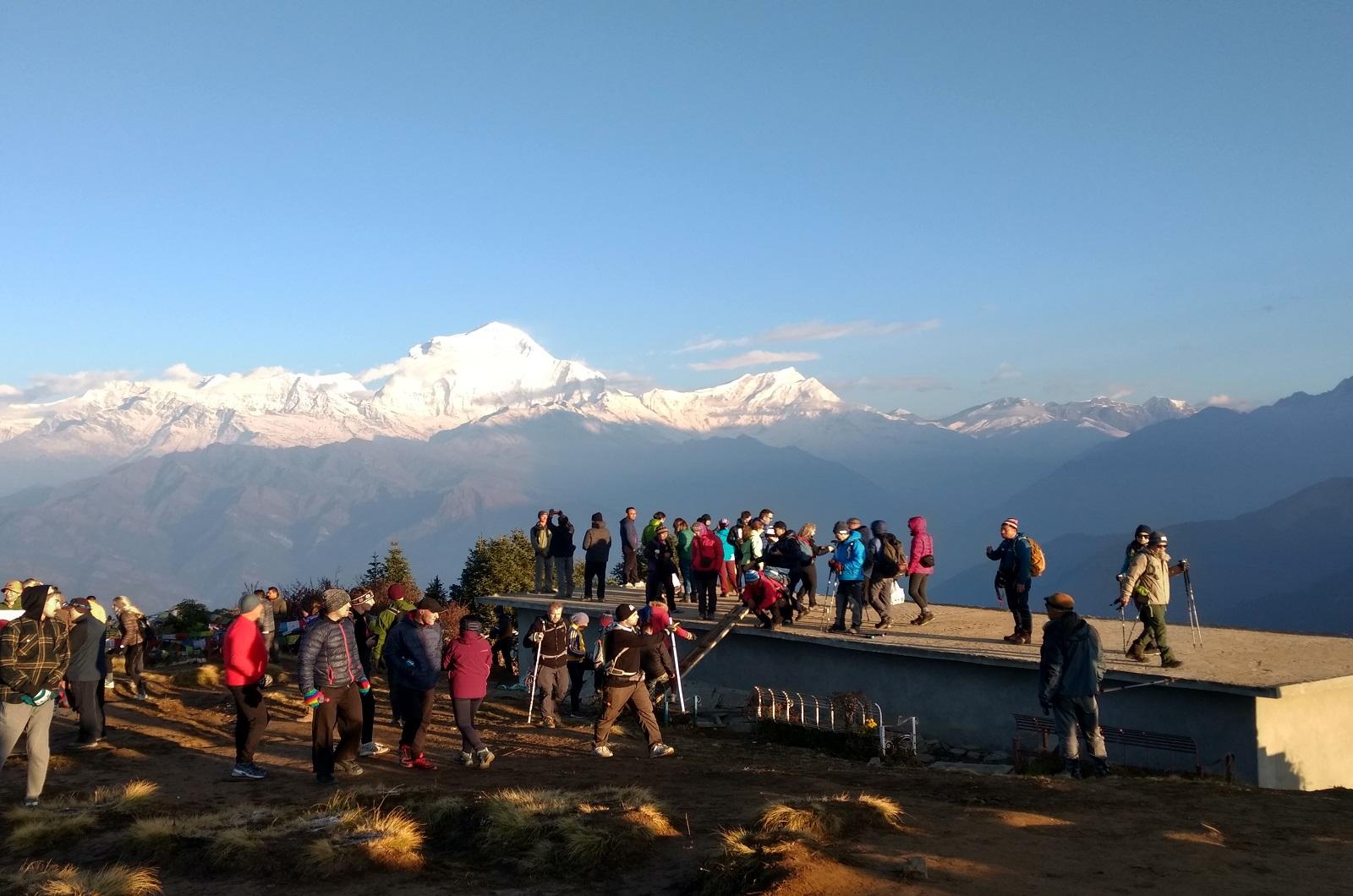
The Poon Hill–Jhinu Hot Spring route blends two of the most admired highlights of the lower Annapurna foothills. The first segment leads adventurers toward Poon Hill (3,210 meters / 10,531 feet), a world-famous viewpoint above Ghorepani village. Here, the sun rises behind Dhaulagiri, Annapurna, Machapuchare (Fishtail), and other glittering summits, creating an unforgettable panorama. The second portion descends into lush valleys and traditional settlements, finally arriving at Jhinu Hot Spring, where natural thermal pools sit beside the roaring Modi Khola River. The combination of crisp mountain air and steamy waters offers a unique sense of both relaxation and renewal.
Location
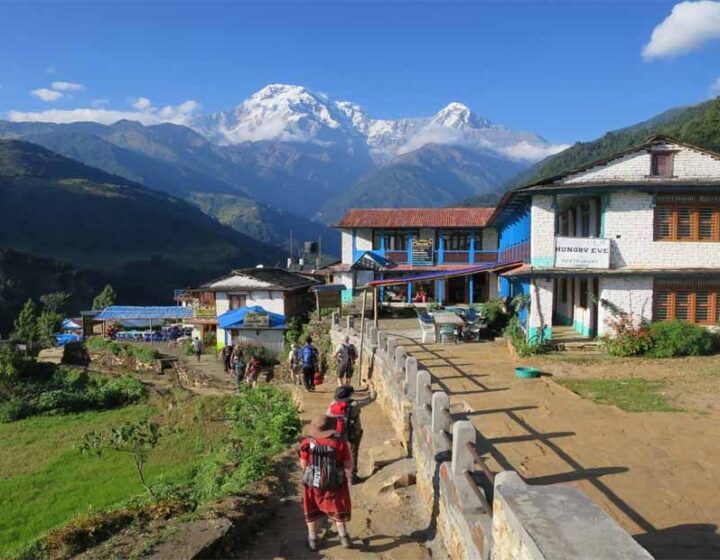
This trek lies within the Annapurna Conservation Area Project (ACAP), one of Nepal’s most biodiverse reserves. Geographically, the trek lies in the Kaski District of western Nepal, close to the popular tourist hub of Pokhara. Villages along the way—such as Ulleri, Ghorepani, Tadapani, and Ghandruk—sit on terraced hillsides surrounded by rhododendron forests and snow-clad peaks. Due to its moderate altitude, the area provides excellent conditions for trekkers of different age groups and fitness levels.
How to Go
The journey normally begins with a scenic drive from Pokhara to Nayapul or Tikhedhunga, the common gateways to the trail. From there, trekkers gradually ascend stone staircases that wind through terraced rice fields, lush bamboo groves, and charming villages. The climb to Ulleri is known for its long stretch of stone steps, while the approach to Ghorepani is filled with rhododendron woodland. After reaching Poon Hill for the sunrise view, the trail descends through Tadapani and Ghandruk, eventually leading to Jhinu Danda. At Jhinu, a short walk downhill brings trekkers to the thermal pools beside the river. The trek can be adjusted depending on time, ranging from 5 to 8 days.
People
The communities inhabiting this trekking corridor are mainly Gurung, Magar, and Thakali ethnic groups, each of which has distinct traditions, attire, and folklore. Specifically, the Magars dominate Ghorepani, whereas Ghandruk serves as a stronghold of Gurung culture. Moreover, these villagers are celebrated for their hospitality, offering warm greetings and homely lodges to visitors. In addition, their resilience and cheerful spirit reflect generations of living in harmony with the mountainous landscapes. Furthermore, many men from these communities historically served in the British and Indian Gurkha regiments, a heritage that continues to inspire pride today.
Accommodation
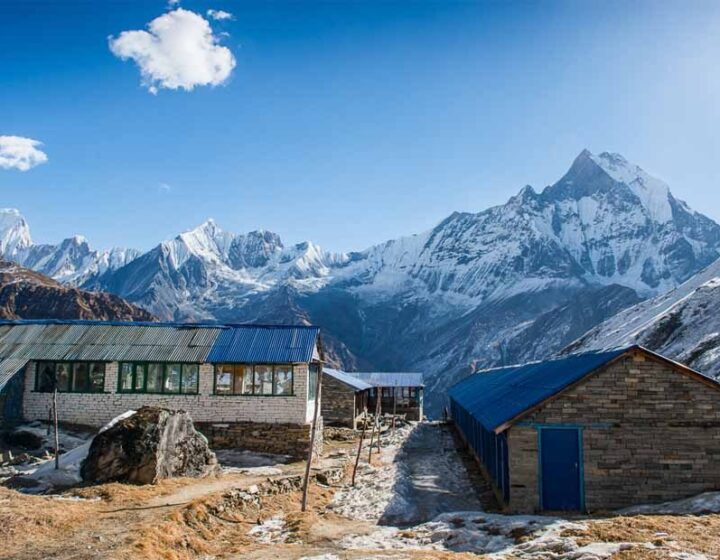
Throughout the trek, trekkers find comfortable teahouses and guesthouses, providing warm meals, cozy rooms, and traditional Nepalese hospitality. The lodges are often family-run, which creates an intimate atmosphere where travelers can interact with locals. Rooms are usually simple, furnished with wooden beds and blankets, while shared dining halls often feature wood stoves that provide warmth during chilly evenings. In recent years, modern amenities such as solar showers, Wi-Fi, and charging facilities have also become available in many places. Staying in these lodges allows trekkers to experience both comfort and cultural closeness.
Religious Practices
The trekking route passes through areas deeply influenced by Hinduism and Buddhism. Travelers notice small shrines, mani walls carved with Buddhist prayers, and colorful prayer flags along the trails. In villages like Ghandruk, monasteries serve as active centers of Buddhist practice, while Hindu temples stand near farmlands and rivers. Local rituals, seasonal festivals, and daily offerings to deities remain integral to village life. Pilgrims and travelers alike find spiritual inspiration in the quiet harmony of faith that pervades the region.
Lifestyle
The lifestyle of the local people revolves around subsistence farming, livestock rearing, and tourism services. Villagers cultivate rice, millet, maize, and vegetables on terraced hillsides, while also tending to cattle, goats, and buffaloes. Handicrafts, weaving, and cultural dances form part of their social identity. With trekking tourism providing an important livelihood, many households operate lodges, sell local produce, or work as porters and guides. Despite modern influences, traditional customs, songs, and communal gatherings remain at the heart of village life. The lifestyle is simple yet deeply connected to nature and tradition.
Flora and Fauna
The Poon Hill–Jhinu Hot Spring trek falls within the rich biodiversity of the Annapurna Conservation Area. The region is famous for its rhododendron forests, which bloom vibrantly in spring, painting the hillsides with shades of red, pink, and white. Oak, bamboo, and maple also flourish in the lower elevations, while alpine shrubs dominate the higher ridges. Wildlife sightings may include Himalayan langurs, barking deer, musk deer, and numerous species of pheasants—including Nepal’s national bird, the colorful Danphe. Birdwatchers are often enchanted by the melodic calls of cuckoos, warblers, and sunbirds along the trail.
Vegetation
Vegetation changes dramatically with altitude. The lower stretches near Nayapul are covered in subtropical vegetation, including banana groves, cardamom, and citrus orchards. As the trail ascends, lush temperate forests appear, dominated by rhododendron, pine, and oak. Near Poon Hill, the landscape transitions into alpine meadows and dwarf shrubs, which survive harsh winds and colder climates. This gradual transformation of greenery adds charm to the trek, making every day’s walk visually different.
Atmosphere
The atmosphere of the Poon Hill–Jhinu Hot Spring trek is serene, refreshing, and rejuvenating. Mornings are filled with crisp mountain air and golden sunlight illuminating snowy peaks. Days are alive with the laughter of local children, the rhythm of footsteps on stone trails, and the scent of blooming flowers. Evenings bring calmness as trekkers gather in lodges by the fire, exchanging stories under a starlit sky. At Jhinu Hot Spring, the blend of rushing river sounds with the warmth of natural pools creates a tranquil ambiance, perfect for relaxation after days of walking.
Most Popular Trekking Region in Nepal
Trekkers celebrate the Annapurna region, where this trek lies, as one of the most popular trekking zones in Nepal. Its mix of accessible trails, cultural richness, and majestic mountain views draws visitors from around the world. Many travelers choose the Poon Hill–Jhinu Hot Spring trek for its short duration and immense rewards. Unlike strenuous high-altitude treks, this journey is easier to complete; moreover, it provides a taste of Himalayan grandeur while still sparing travelers the need for extensive acclimatization. The opportunity to witness sunrise over the Annapurna and Dhaulagiri ranges, followed by a rejuvenating dip in natural hot springs, makes this journey a true gem among Nepalese adventures.
The Himalayan Realms Treks and Expedition Nepal Pvt. Ltd.
For trekkers seeking a safe, expertly guided adventure, Himalayan Realms Treks is your trusted partner. With decades of experience across Nepal’s mountains, the company delivers authentic cultural experiences and top-notch service.
Guides ensure you enjoy stunning views while learning about local heritage, wildlife, and community life. From smooth logistics to warm hospitality, every step of the Poon Hill–Jhinu Hot Spring trek is seamless and memorable. For Australian, Japanese, European, and global adventurers, the company offers customized itineraries that balance adventure with comfort.
Conclusion
The Poon Hill–Jhinu Hot Spring Trek is more than just a walking holiday—it is a holistic experience of Nepal’s landscapes, traditions, and natural wonders. It blends the breathtaking sight of Himalayan dawn at Poon Hill with the healing embrace of Jhinu’s hot springs. Along the way, trekkers encounter vibrant villages, ancient rituals, hospitable people, and a living museum of flora and fauna. The region’s atmosphere inspires both relaxation and adventure; consequently, it is suitable for families, beginners, and seasoned wanderers alike. Furthermore, as part of the world-renowned Annapurna trekking arena, this journey stands as a shining example of Nepal’s beauty. Ultimately, with The Himalayan Realms Treks and Expedition Nepal Pvt. Ltd. as their trusted guide, travelers experience not just a trek but a transformative journey into the soul of the Himalayas
Itinerary
The journey begins early in the morning, usually around 7:00 am, when the deluxe tourist bus departs from Kathmandu. The drive follows the Prithvi Highway, winding alongside the Trishuli River with views of terraced fields, green hills, and local villages. After about 6–7 hours, you arrive in Pokhara (827 m / 2,713 ft) around 2:00–3:00 pm. Along the way, you will see traditional Nepalese countryside life, riverside markets, and the distant snowcapped peaks of the Annapurna and Manaslu ranges if the weather is clear. Pokhara welcomes you with its calm atmosphere and the beautiful Phewa Lake reflecting the towering Machapuchare, also called Fishtail Mountain (6,993 m / 22,943 ft). This first day is mostly about the scenic road journey and preparing for the trek. The evening can be spent walking along Lakeside Pokhara, enjoying local restaurants, or relaxing before the adventure ahead. Overnight stay in Pokhara.
After breakfast in Pokhara, you leave around 7:30 am by private jeep. The drive takes about three hours along a scenic mountain road, passing through Nayapul (1,070 m / 3,510 ft) and reaching Tirkhedhunga (1,540 m / 5,052 ft) by late morning. From here, the trek begins. You follow the stone steps and suspension bridges across small waterfalls before beginning a steep uphill climb toward Ulleri. The village of Ulleri (2,050 m / 6,725 ft) is reached after about 2–3 hours of walking. The trail is famous for its long staircase with more than 3,000 steps, making it a challenging yet rewarding climb. Along the way, you encounter Magar settlements, terraced farmlands, and wide views of lush valleys. By 3:00 pm, you arrive at Ulleri and can enjoy the panorama of Annapurna South (7,219 m / 23,684 ft) and Hiunchuli. Overnight stay at a local teahouse in Ulleri.
This day begins around 7:00 am after breakfast. From Ulleri (2,050 m / 6,725 ft), the trail gradually climbs through dense rhododendron and oak forests. The path is less steep compared to the previous day, making the walk more pleasant. You pass small villages such as Banthanti (2,250 m / 7,381 ft) and Nangethanti (2,460 m / 8,070 ft), where trekkers often stop for tea or lunch. The forest is alive with bird calls, and during spring, the rhododendrons bloom in red and pink, creating a magical atmosphere. After about 5–6 hours of trekking, you reach Ghorepani (2,874 m / 9,429 ft) by mid-afternoon, around 2:00–3:00 pm. Ghorepani is a charming Magar village, famous as the gateway to Poon Hill. From here, the peaks of Dhaulagiri (8,167 m / 26,795 ft) and Annapurna South can already be seen. The evening is often cool and misty, with a cozy village atmosphere. Overnight in Ghorepani.
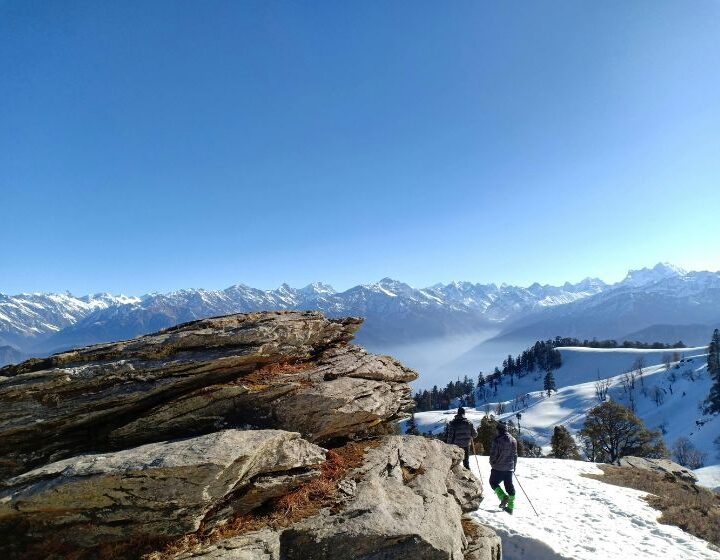
Wake up very early, around 4:30 am, for the highlight of the trek—a sunrise hike to Poon Hill. The climb takes about 45 minutes to reach the top (3,210 m / 10,531 ft). As dawn breaks, the golden sunlight touches the peaks of Dhaulagiri, Annapurna I, Machapuchare, Hiunchuli, and Nilgiri, offering one of the most breathtaking panoramas in Nepal. After spending time enjoying the sunrise and photography, return to Ghorepani for breakfast. Around 8:00 am, begin trekking toward Tadapani (2,630 m / 8,628 ft). The trail climbs and descends through rhododendron forests and open ridges, offering changing mountain views and serene woodland paths. You pass through Deurali and Banthanti before reaching Tadapani by mid-afternoon, around 2:00–3:00 pm. Tadapani provides close-up views of Annapurna South, Hiunchuli, and Machapuchare. This day combines adventure, beauty, and rewarding landscapes, making it a highlight of the trek. Overnight at Tadapani.
The day begins around 7:00 am as you descend from Tadapani (2,630 m / 8,628 ft) through lush forests of rhododendron and oak. The trail gradually drops toward the Gurung village of Chhomrong (2,170 m / 7,119 ft), a beautiful settlement perched on a ridge with sweeping views of Machapuchare and Annapurna South. After lunch here, the path descends steeply down stone steps to Jhinu Danda (1,780 m / 5,840 ft), arriving by mid-afternoon around 2:00–3:00 pm. Jhinu is well-known for its natural hot springs, located about 20 minutes downhill from the village, right beside the Modi Khola River. After days of trekking, a dip in these soothing warm pools is refreshing and relaxing. The evening atmosphere in Jhinu is peaceful, surrounded by forests and the sound of flowing rivers. This is one of the most rewarding stops on the trek. Overnight stay in Jhinu.
Today’s trek is relatively short and relaxed. Starting after breakfast around 8:00 am, the trail descends to the river and crosses a suspension bridge before climbing gradually toward Landruk (1,565 m / 5,134 ft). The walk takes about 3–4 hours, arriving by late morning or around midday. Landruk is a large Gurung village set on a hillside, with terraced fields surrounding the settlement. From here, there are excellent views of Annapurna South, Hiunchuli, and the valley below. The pace is slower today, allowing trekkers to enjoy village life, interact with locals, and rest after previous long walks. Landruk offers a more authentic cultural experience, where traditional houses and local farming lifestyles can be observed. The afternoon can be spent exploring the village or relaxing with views of the river valley. Overnight stay in a comfortable teahouse in Landruk, enjoying both mountain scenery and warm hospitality.
After breakfast around 7:30 am, the final day of trekking begins from Landruk (1,565 m / 5,134 ft). The trail gently ascends through terraced fields, traditional Gurung houses, and small forest patches, offering glimpses of local farming life and pastoral landscapes. Along the way, trekkers enjoy sweeping views of Annapurna South (7,219 m / 23,684 ft), Hiunchuli (6,441 m / 21,122 ft), and Machapuchare (6,993 m / 22,943 ft), which appear majestic against the morning sky. The path meanders through the peaceful village of Dhampus (1,650 m / 5,413 ft), known for its panoramic viewpoints and friendly locals. After a few hours of walking, you reach Dhampus around midday and take a short drive downhill to Pokhara (827 m / 2,713 ft), arriving in the early afternoon. The journey offers both relaxation and reflection, with opportunities for photography, last glimpses of Himalayan peaks, and enjoying the serene countryside. Pokhara marks the end of the trek, with comfortable accommodations and lakeside leisure awaiting.
After a memorable trek, the journey back to Kathmandu begins either by a short scenic flight or a comfortable tourist deluxe bus. For the flight option, travelers usually depart Pokhara Airport (827 m / 2,713 ft) in the morning, around 7:00–8:00 am. The 25–30-minute flight offers spectacular aerial views of the Annapurna and Manaslu ranges, along with Pokhara Valley and Phewa Lake below. Flying is quick, convenient, and a thrilling way to see the Himalayas from above. Alternatively, the deluxe bus departs Pokhara around 7:00–8:00 am along the Prithvi Highway, reaching Kathmandu (1,350 m / 4,429 ft) after 6–7 hours. The road winds alongside rivers, terraced hills, and bustling roadside villages, giving travelers a closer look at Nepalese life. Both options allow time to reflect on the trek, enjoy scenic beauty, and conclude the journey comfortably. Arrival in Kathmandu marks the end of the adventure, with opportunities for sightseeing or relaxing in the capital city.
On the last day of your Nepal journey, after breakfast, you will check out from your hotel in Kathmandu (1,350 m / 4,429 ft) and prepare for your transfer to Tribhuvan International Airport (TIA). The departure time is usually scheduled based on your international flight, often around 2–3 hours before takeoff. The drive to TIA takes approximately 30–45 minutes, depending on traffic, along busy city roads lined with local markets, temples, and historic buildings. During the journey, you can reflect on your unforgettable experiences in the Himalayas, the cultural encounters in Pokhara and Kathmandu, and the scenic trekking adventure through the Annapurna region. At the airport, hotel staff and tour representatives assist with luggage handling, check-in, and final formalities. This transfer marks the conclusion of your Nepal adventure with The Himalayan Realms Treks, leaving cherished memories of mountains, rivers, villages, and warm Nepalese hospitality.
Included
- All airport, hotel airport transfers.
- Flight fare from Kathmandu to Pokhara
- Transfers Pokhara airport to Tirkheghunga.
- Conservation permit.
- Accommodation in the tea house
- Food, Tea/coffee during trek.
- Guide: – including salary, insurance, equipment, flight, food and lodging.
- Porter: – including salary, insurance, equipment, food and lodging.
- For guest: -Down jacket, Good sleeping bag (down jacket and sleeping bag are to be returned after trip completion).
- Transfer from Kyumi to Pokhara
- Transfer from Pokhara hotel to Airport
- Transfer from Kathmandu Airport to hotel in Kathmandu
- All government and local taxes.
- Final departure from hotel to international airport transfer.
Not Included
- Food in Kathmandu ( Lunch & Dinner). Kathmanmdu and Pokhara.
- 2 Night Hotel in Kathmandu
- 2 Night hotel in Pokhara
- Bakery food during the trek.
- Nepal Visa fee.
- International airfare.
- Extra night accommodation in Kathmandu.
- Sightseeing sport fees. tours guide cost and vechicle cost
- Travel and rescue insurance if guest get mountain sickness and need to rescue helicopter.
- Personal expenses example (phone calls, laundry service , bar bills, battery recharge, WIFI charge, extra porters, bottle water or boiled water, shower etc.)
- Tips for guide and porters
Join Us Upcoming Trips
Book this trip with us. Here are the upcoming dates. Feel free to share this trip with your friends and family. For custom trips or general inquiries contact us.
| Departure Date | Trip Duration | Price | Status | |
|---|---|---|---|---|
| 05 March, 2026 | 6 days | USD $1050 | Fixed departure | |
| 13 March, 2026 | 6 days | USD $1050 | Fixed departure | |
| 25 March, 2026 | 6 days | USD $1050 | Fixed departure | |
| 03 April, 2026 | 6 days | USD $1050 | Fixed departure | |
| 12 April, 2026 | 6 days | USD $1050 | Fixed departure | |
| 25 April, 2026 | 6 days | USD $1050 | Fixed departure | |
| 07 May, 2026 | 6 days | USD $1050 | Fixed departure | |
| 15 May, 2026 | 6 days | USD $1050 | Fixed departure | |
| 25 May, 2026 | 6 days | USD $1050 | Fixed departure | |
| 07 September, 2026 | 6 days | USD $1050 | Fixed departure | |
| 20 September, 2026 | 6 days | USD $1050 | Fixed departure | |
| 04 October, 2026 | 6 days | USD $1050 | Fixed departure | |
| 15 October, 2026 | 6 days | USD $1050 | Fixed departure | |
| 26 October, 2026 | 6 days | USD $1050 | Fixed departure | |
| 06 November, 2026 | 6 days | USD $1050 | Fixed departure | |
| 25 November, 2026 | 6 days | USD $1050 | Fixed departure | |
| 10 December, 2026 | 6 days | USD $1050 | Fixed departure | |
| 25 December, 0006 | 6 days | USD $1025 | Fixed departure |
Useful Info
The Poon Hill Jhinu Hot Spring Trek is located in the Annapurna region of Nepal. It is one of the most beautiful trekking routes. Trekkers see stunning mountain views, green forests, and charming villages along the way.
The trek reaches a high point at Poon Hill, 3,210 meters (10,531 feet). From here, you can see the sunrise over the Himalayas, including the Dhaulagiri, Annapurna, and Machapuchare peaks.
Along the trek, you will pass Ulleri, Ghorepani, Tadapani, and Jhinu Danda villages. At Jhinu Danda, you can relax in natural hot springs. The hot springs are surrounded by rivers and green hills, making it a perfect place to refresh.
For the trek, we pack light clothing, a good pair of trekking shoes, a rain jacket, and a headlamp. Warm clothes are needed for early morning hikes to Poon Hill, as it can be cold. Water bottles, snacks, and a camera are also important.
The trek is moderate, so a basic level of fitness is enough. You will enjoy peaceful forests, rhododendron blooms in spring, and local culture in villages. The scenery is truly breathtaking, making this trek memorable for nature lovers and photographers.
FAQs
-
What is the Poon Hill–Jhinu Hot Spring 7-Day Trek?
The Poon Hill–Jhinu Hot Spring Trek is a short and scenic journey in Nepal’s Annapurna region. It combines the famous Poon Hill sunrise viewpoint with traditional Gurung villages and a relaxing natural hot spring at Jhinu Danda. This trek is ideal for travelers who want Himalayan views, culture, and comfort in a limited time.
-
How difficult is the Poon Hill–Jhinu Hot Spring Trek?
This trek is considered easy to moderate. Daily walking hours range from 4 to 6 hours. The trails are well maintained, with stone steps and forest paths. It is suitable for beginners, families, and trekkers of all ages with a reasonable fitness level.
-
What is the highest altitude on this trek?
The highest point of the trek is Poon Hill at 3,210 meters. Because the altitude is not very high, the risk of altitude sickness is minimal. However, walking slowly and drinking enough water is still important.
-
What mountains can be seen during the trek?
From Poon Hill and along the trail, trekkers can enjoy panoramic views of Annapurna South, Annapurna Frank, Annapurna II III, IV, Dhampus peak, Tukuche peak, Dhaulagiri,Gorja Himal, Mukut Himal, Butterfly Mountain, Machhapuchhre (Fishtail), Hiunchuli, and Nilgiri. Gandarva chuli and Lamjung Himal and the sunrise from Poon Hill is one of the best mountain views in Nepal.
-
What is special about Jhinu Hot Spring?
Jhinu Hot Spring is a natural hot water pool beside the Modi Khola river. After several days of trekking, soaking in the warm water helps relax tired muscles. The hot spring is about a 20–30 minute downhill walk from Jhinu Danda.
-
What kind of accommodation is available on this trek?
Accommodation is in local teahouses and lodges. Rooms are simple but clean, usually with twin beds. Meals are served in dining areas, and hot showers are available in most places, sometimes for an extra cost.
-
What food is available during the trek?
Teahouses serve a variety of meals such as dal bhat, noodles, pasta, fried rice, soups, eggs, potatoes, and local bread. Dal bhat is the most popular choice as it is filling and nutritious. Vegetarian food is widely available.
-
Is this trek crowded?
Poon Hill is popular, especially during peak seasons. However, the trail toward Jhinu Hot Spring is generally quieter. Compared to Everest Base Camp, this trek feels less busy and more relaxed.
-
Do I need permits for this trek?
Yes, trekkers need an Annapurna Conservation Area Permit (ACAP) and a TIMS card. These permits are easily arranged through a trekking company in Nepal.
-
Why choose Himalayan Realms Treks for this trek?
Himalayan Realms Treks offers experienced local guides, flexible itineraries, fair pricing, and personal service. With deep knowledge of the Annapurna region, the company ensures a safe, enjoyable, and culturally rich trekking experience from start to finish.