

Overview: Mount Kailash
Introduction
Mount Kailash is not just a geographical marvel; it is a beacon of spiritual magnitude, natural beauty, and cultural depth. Revered across multiple faiths and nestled in the remote corners of the Tibetan Plateau, this mountain stands isolated, untouched, and enigmatic. Unlike other climbing destinations in the Himalayas, Mount Kailash remains unconquered—not because of its technical difficulty, but because of its divine status. Managed and promoted by The Himalayan Realms Treks and Expedition Nepal Pvt. Ltd., this sacred circuit, also known as the Kora, invites pilgrims and adventurers alike to embark on a journey of spiritual rejuvenation and natural immersion.
About Mount Kailash
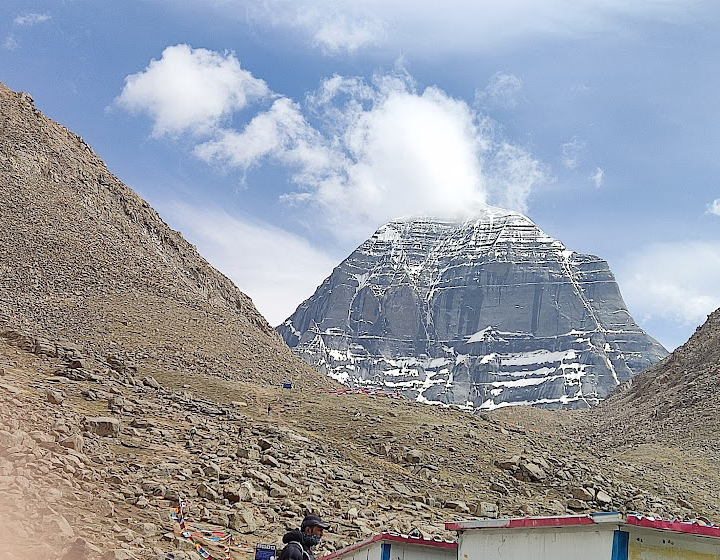
Rising to an elevation of 6,638 meters (21,778 feet), Mount Kailash is part of the Trans-Himalayan range in western Tibet. It is considered a celestial axis or spiritual pivot for four major religions—Hinduism, Buddhism, Jainism, and Bon. While trekkers may explore various paths in the Himalayan realm, none match the sanctity and symbolic intensity of Kailash. The peak remains untouched by mountaineers, out of reverence, with circumambulation replacing summiting as the ultimate pilgrimage.
Geographic Placement
Mount Kailash is situated in the Ngari Prefecture of the Tibet Autonomous Region, China. It lies near the sources of four major Asian rivers—the Indus, Sutlej, Brahmaputra (Yarlung Tsangpo), and Karnali (a tributary of the Ganges). The neighboring Lake Manasarovar, one of the world’s highest freshwater lakes, adds even more spiritual resonance to the region. Surrounded by arid terrain and rugged escarpments, this isolated site commands deep reverence and intrigue.
How to Reach Mount Kailash
The overland journey to Mount Kailash begins in Kathmandu, Nepal’s capital. From here, travelers drive north toward Syabrubesi, a scenic village near the Tibetan border. The road winds through lush hills and traditional settlements before reaching the Rasuwagadhi border crossing. After immigration formalities, you enter Tibet and continue to Kerung (Gyirong), a quiet border town where acclimatization begins.
From Kerung, the route moves through dramatic landscapes—plateaus, mountain passes, and remote valleys—to reach Saga, a small town that serves as a key resting point. After an overnight stop in Saga, the journey advances toward Paryang, a windswept settlement surrounded by arid terrain. The scenery becomes increasingly stark and majestic as you near Lake Manasarovar, one of the holiest lakes in Asia. A night by the lake allows travelers to soak in its peaceful ambiance and spiritual energy.
From Manasarovar, it’s a short drive to Darchen, the base for the Mount Kailash Kora (circumambulation). The three-day trek begins here and proceeds to Dirapuk (Terapuk) for the first night. On the second day, you cross the high Dolma-La Pass and descend to Zuthulpuk (Jutulpuk), where you rest before completing the circuit and returning to Darchen.
After the Kora, the return journey retraces the route through Saga, Kerung, and finally back to Kathmandu. This overland route offers a balance of cultural immersion, physical challenge, and spiritual fulfillment—an unforgettable path to the sacred Mount Kailash.
Local Inhabitants and Culture
The surrounding territory of Kailash is sparsely inhabited, primarily by Tibetan nomads and local villagers. These residents, despite the harsh conditions, carry a deep spiritual connection with the land. Their hospitality is modest yet heartfelt. The local culture blends Buddhism and Bon traditions, which are visible in prayer flags, chortens, and intricately carved mani stones scattered throughout the landscape. The people are reserved yet spiritual, deeply respectful of both nature and visitors.
Accommodation Options
Accommodation around Mount Kailash varies based on location. In towns like Taklakot and Darchen, travelers can find relatively comfortable lodges with standard facilities—warm bedding, private rooms, decent bathrooms, and sometimes even Wi-Fi. However, during the Kora itself—especially at Dirapuk (Terapuk) and Zuthulpuk (Jutulpuk) monasteries—the lodging becomes far more rudimentary. Here, only shared dormitories are available with basic sanitation. Toilets in these sections are often makeshift or poorly maintained. While the stay might lack modern comforts, the raw authenticity of these accommodations only deepens the spiritual experience. Other rest points, however, offer better lodging with clean, well-maintained toilets and separate rooms.
Religious Significance
Mount Kailash holds unmatched sanctity in four major world religions. Hindus believe Lord Shiva resides atop the mountain, meditating in eternal stillness. Buddhists associate the mountain with Demchok (Chakrasamvara), representing supreme bliss. Jains believe it to be the site where their first Tirthankara, Rishabhadeva, attained nirvana. For followers of the ancient Bon faith, Kailash is a spiritual energy center and the seat of the sky god Sipaimen.
Pilgrims from all corners of the world perform the Kora, a 52-kilometer circumambulation, in reverence. Hindus and Buddhists walk clockwise, while Bon practitioners go counterclockwise. Many believe that completing a single Kora cleanses lifetimes of sins, while completing 108 brings salvation.
Way of Life in the Kailash Region
Life around Mount Kailash is shaped by simplicity and devotion. The people here follow a nomadic or semi-nomadic existence, herding yaks and sheep, and engaging in small-scale trade. Their lifestyle is dictated by the altitude and weather. Food is basic—tsampa (roasted barley flour), butter tea, noodles, and yak meat are common staples. Despite their limited means, their resilience and spiritual depth are profound. Prayer flags flutter across rooftops, and spinning prayer wheels are integrated into daily routines, symbolizing the omnipresence of faith.
Flora and Fauna
While the landscape may appear barren, the Kailash region supports unique and hardy ecosystems. Alpine grasses, mosses, and small flowering shrubs like edelweiss thrive during brief summers. Medicinal herbs such as rhodiola and cordyceps are found in the higher belts. In terms of wildlife, visitors may spot wild asses (kiangs), Himalayan marmots, Tibetan antelope (chiru), and blue sheep (bharal). The elusive snow leopard also inhabits the region but is rarely seen. Birds like lammergeiers, Himalayan griffons, and choughs add life to the expansive skies.
Vegetation Overview
Vegetation around Mount Kailash varies from alpine steppe to arid desert scrub. Owing to its altitude and aridity, trees are virtually absent. Instead, resilient flora adapted to harsh winds, cold temperatures, and nutrient-poor soil dominate. During the summer months, patches of green emerge, particularly in areas near streams and rivers, offering temporary grazing grounds for livestock and wild herbivores.
Atmosphere and Climate
The air at Mount Kailash is thin, crisp, and often bitingly cold. The region experiences extreme weather variability—from scorching sun to sudden snowfall. The high elevation (often above 4,500 meters throughout the circuit) demands proper acclimatization. The skies are frequently crystal clear, making sunrise and sunset moments especially magical. Despite the physically demanding terrain, the atmosphere carries a sense of serenity and timelessness—a feeling that this land belongs to a higher realm.
Popularity in Trekking Circles
Although not a traditional trekking destination like the Everest or Annapurna regions, Mount Kailash is a bucket-list pilgrimage for serious trekkers and spiritual seekers. The physical demands of the Kora, coupled with the spiritual pull of the mountain, make it one of the most soul-stirring expeditions in the Himalayan belt. Trekkers often describe the journey as more than physical; it becomes a path of inner transformation. The trail’s challenging altitudes, barren beauty, and intense solitude appeal to those who seek something beyond mere adventure.
Our Company’s Role—The Himalayan Realms Treks and Nepal Freelance Guide Services:
The Himalayan Realms Treks and Expedition Nepal Pvt. Ltd., under the experienced leadership of Mr. Dammaru Prasad Niraula—who has over 35 years in the Himalayan tourism field—offers well-organized Kailash journeys that balance spiritual depth, physical safety, and cultural exposure. With Mr. Niraula also leading as the Nepal Freelance Guide, the team brings extensive trail knowledge, altitude preparedness, and language fluency to every step of the pilgrimage. The company ensures ethical guiding practices, uses eco-conscious logistics, and emphasizes client acclimatization and comfort.
Whether you’re a pilgrim seeking moksha, a Buddhist drawn by tantric devotion, or a traveler chasing serenity, the team helps transform your journey into a seamless experience. They arrange permits, coordinate with Tibetan counterparts, provide oxygen support when necessary, and ensure that every stop along the Kora—from Darchen to Dirapuk to Zuthulpuk—is logistically secure and spiritually fulfilling.
Conclusion
Mount Kailash is not simply a destination—it is a revelation. Towering in solitude and cloaked in mysticism, it calls to those who seek both the sacred and the sublime. While the physical terrain may be demanding, the emotional and spiritual rewards are beyond compare. With the expert guidance of The Himalayan Realms Treks and Nepal Freelance Guide Services, every pilgrim and trekker can embark on this extraordinary odyssey safely, respectfully, and meaningfully.
In the stillness of Dirapuk, under the shadow of Kailash, or during the early morning light at Zuthulpuk, each moment affirms that this journey is unlike any other—a rare confluence of earth, sky, and spirit. Let The Himalayan Realms Treks be your guide to this once-in-a-lifetime experience.