

Overview: Rhododendron Flowers
Rhododendron: Nepal’s Beautiful Mountain Flower
Rhododendron is one of the most beautiful and famous flowering plants found in cool mountain areas around the world. Its name comes from the Greek words rhodon (which means “rose”) and dendron (which means “tree”). This makes sense, as its flowers look like roses and its stems are thick and woody like small trees. Known for both its bright colors and its role in nature, Rhododendron grows well on mountain slopes, especially in the Himalayas. Its thick green leaves and bright flowers stand out clearly against the misty and rugged hills.
There are over 1,000 different types of Rhododendron around the world. They can be small bushes or grow as tall as trees. These plants are found in many parts of Asia, Europe, and North America. But in Nepal and nearby Himalayan countries, Rhododendrons are more than just pretty flowers. They are an important part of the local culture, traditional healing, forest life, and even the tourism trade.
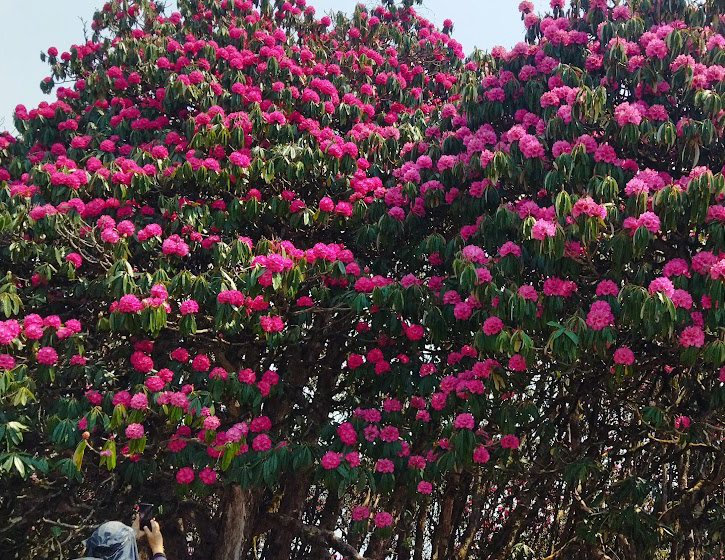
When spring arrives, Nepal’s hills light up with red, pink, white, purple, and yellow flowers as the Rhododendrons bloom. These flowers attract many trekkers, nature lovers, and photographers each year. Famous trekking areas like Langtang, Ghorepani, and the lower parts of Everest are especially known for Rhododendron forests. Whether you’re walking the Annapurna Circuit or exploring a quiet valley, these flowers make the journey more colorful and meaningful.
For The Himalayan Realms Treks and Expedition Nepal Pvt. Ltd., Rhododendrons are more than just a beautiful sight—they are a part of what makes trekking in Nepal truly special.
About Rhododendron
Belonging to the Ericaceae family, Rhododendron is recognized worldwide for its diversity and adaptability. The genus has thrived across a variety of climates and altitudes, and its evolution is a testament to biological resilience. In Nepal, these flowering marvels are found in about 30 out of 77 districts, mostly concentrated in mid-hill and high-hill regions. Among the 30+ Rhododendron species in Nepal, the Rhododendron arboreum, locally called Lali Gurans, stands out the most. With its vivid red blossoms and lush green foliage, it was declared Nepal’s national flower—a fitting honor for such a magnificent and widespread plant.
Rhododendrons flourish in mixed forest habitats, often alongside oaks, firs, and pine species. These plants are mostly evergreen, with thick, leathery leaves that persist throughout the year. During spring, their densely clustered blossoms attract numerous pollinators—bees, butterflies, and birds—thereby playing a vital role in sustaining forest biodiversity. But Rhododendrons are far more than just beautiful. They help prevent soil erosion, aid in maintaining forest health, and provide raw materials for local medicines and food items.
For Himalayan Realms Treks, Rhododendrons enrich every trekking trail they touch. Their presence allows for thematic treks that blend eco-tourism, cultural storytelling, and nature education, creating unforgettable journeys through Nepal’s vibrant mid-hills and alpine landscapes.
How High We Get Rhododendron
One of the most fascinating aspects of Rhododendron is its altitudinal range. In Nepal, people find these plants at elevations ranging from 1,200 meters (3,900 feet) up to 4,000 meters (13,100 feet). This wide elevation range creates remarkable diversity in their forms and colors. In the lower zones, species grow larger, sometimes forming full trees. As trekkers ascend into alpine regions, Rhododendrons adopt more compact, shrubby shapes, hugging the ground to shield themselves from wind and cold.
The shift from subtropical valleys to alpine forests also brings changes in Rhododendron species. Middle elevations—between 2,000 and 3,000 meters—feature especially rich growth, providing some of Nepal’s most picturesque Rhododendron trails. The Ghorepani-Poon Hill trail, for example, draws visitors worldwide with its forests bursting into vibrant colors each spring. Similarly, the Singalila Ridge and Langtang Valley transform into floral paradises during bloom season.
These floral corridors do more than captivate the eye—they enhance the entire trekking experience. By promoting Rhododendron treks within this altitude range, The Himalayan Realms Treks offers comfortably paced, visually stunning, and biodiversity-focused adventures, ideal for both seasoned trekkers and casual nature enthusiasts.
National Flower of Nepal
The Rhododendron arboreum, or Lali Gurans, holds a revered place in Nepali identity as the national flower. The vivid red hue of its blossoms mirrors the passion, courage, and natural wealth of Nepal. Officially adopted by the government, its selection is rooted in both its widespread presence and cultural symbolism.
In Nepalese culture, Lali Gurans symbolizes renewal, love, and vitality. Its spring bloom coincides with seasonal festivals and marks the end of winter’s dormancy. The flower features in poems, songs, and traditional stories. School children sing patriotic anthems that mention Lali Gurans, and locals often decorate altars or make offerings using these blooms during springtime rituals.
For trekkers journeying with The Himalayan Realms Treks, witnessing the Lali Gurans in full bloom is akin to experiencing the soul of Nepal. It brings together the natural and the national, forming a living emblem that defines the rhythm and resilience of Himalayan life.
How Many Kinds of Rhododendron in Nepal
Despite its relatively small landmass, Nepal hosts about 32 species of Rhododendron—a figure that reflects its incredible biodiversity. This is made possible by the country’s dramatic vertical topography. Within a few hundred kilometers, Nepal spans ecosystems ranging from tropical plains to snowy mountain peaks, creating microhabitats ideal for different Rhododendron species.
Each species differs in flower color, leaf structure, and growth habit. While Rhododendron arboreum is the tallest and most widely recognized, other species like Rhododendron lepidotum and Rhododendron anthopogon grow close to the ground, emitting aromatic oils and producing yellow or pink blooms.
One of the world’s richest Rhododendron habitats is the Tinjure-Milke-Jaljale trail, located in eastern Nepal, where up to 28 species can be found in a single zone. This unparalleled diversity allows The Himalayan Realms Treks to offer botanically themed treks, turning every walk into a learning experience rich with ecological insight.
Medicinal Uses of Rhododendron Flowers
For centuries, Rhododendrons have served as natural remedies in the traditional medicine systems of Nepal.
Particularly in rural areas, where access to modern healthcare remains limited, people use various parts of the Rhododendron plant to treat ailments. Villagers often sun-dry the flowers of Rhododendron arboreum and prepare herbal teas, which they believe help manage high blood pressure, digestive disorders, and cholesterol levels.
In folk practice, people drink the flowers’ juice for blood purification and sometimes take it to reduce fever or relieve headaches. They also apply paste made from the petals directly to the skin, while fermented drinks from the flowers provide warmth and offer mildly therapeutic effects.
Recent phytochemical studies support some of these traditional uses, identifying flavonoids, tannins, and saponins as active compounds in Rhododendrons. However, it’s essential to note that not all species are safe for medicinal use. Therefore, The Himalayan Realms Treks ensures that guides educate travelers about safe vs. unsafe plant species, blending folklore with scientific caution to create a responsible and informative trekking experience.
What Type of Poison Found in Rhododendron
Despite their medicinal properties, Rhododendrons can be toxic if misused. Some species contain grayanotoxins, neurotoxic compounds that disrupt sodium channels in the body. Ingesting these toxins—either through leaves, flowers, or honey made from their nectar—can cause symptoms such as nausea, dizziness, low blood pressure, and irregular heartbeat. Bees collect nectar from Rhododendron flowers and produce a well-known byproduct called “mad honey.” In some cultures, people highly value this honey for its hallucinogenic and medicinal properties; however, consuming it in excess can cause serious health risks. In Nepal, practitioners sometimes administer small doses under controlled conditions, but authorities generally discourage its use among the public.
To ensure the safety of travelers, The Himalayan Realms Treks incorporates safety briefings into treks that pass through Rhododendron zones. This includes information on identifying edible varieties, avoiding poisonous parts, and respecting local knowledge systems that have long coexisted with these complex plants.
When Does Rhododendron Bloom
The blooming season of Rhododendrons is a natural event that Nepalese people and visitors eagerly await. Depending on the region and elevation, flowering typically occurs from late February to early May. Lower altitudes bloom earlier, while higher zones follow with a lag of a few weeks.
This period transforms Nepal’s hills into vibrant floral landscapes, with entire mountainsides painted in bold colors. Treks through Ghorepani, Langtang, Helambu, and Makalu-Barun are especially popular during this time. The crisp mountain air, mild temperatures, and clear skies provide perfect trekking conditions.
To capitalize on this seasonal splendor, The Himalayan Realms Treks offers special “Rhododendron Blossom Trekking” packages, aligning itineraries with peak bloom times. These treks are transformed into immersive experiences, where each step is enriched with fragrance, color, and biodiversity.
Conclusion:
Rhododendron is far more than just a flower in Nepal. It embodies the cultural spirit, ecological wealth, and scenic glory of the nation. From preventing erosion to nourishing pollinators, from featuring in folklore to healing villagers, it plays countless roles.
At The Himalayan Realms Treks and Expedition Nepal Pvt. Ltd., we see Rhododendrons as a bridge between tourism and environmental education. Our mission is to guide travelers through Nepal’s most Rhododendron-rich trails, offering deep insight into the country’s natural legacy and local traditions. These treks are not just physical journeys—they are spiritual and educational odysseys through forests where every petal tells a story.
We invite you to join us during the Rhododendron bloom season, to walk beneath blossoming canopies and through forests perfumed with spring. Let these flowers lead your path through Nepal’s mystical heights, and discover a landscape where nature, culture, and adventure unite.